


What does it mean to be born in the Year of the Rabbit?
In Chinese culture, the Rabbit is associated with gentleness, intelligence, sensitivity, and quiet strength. Traditional interpretations often describe Rabbit-born people as observant, thoughtful, diplomatic, and able to adapt to different situations.
But the Chinese Zodiac Rabbit represents much more than a gentle personality or good fortune.
In traditional Chinese metaphysics, each zodiac animal is connected to an ancient system of timekeeping, the Five Elements, and the balance of Yin and Yang. Your birth year also determines which type of Rabbit you are.
For example, someone born in 1987 is traditionally known as a Fire Rabbit, while someone born in 1999 is an Earth Rabbit. Both are Rabbit signs, but their birth years carry different elemental classifications.
In this guide, you’ll discover the cultural meaning of the Rabbit, its traditional personality traits, love compatibility, career and wealth symbolism, and how the Five Elements and Bazi add deeper layers to your Chinese Zodiac sign.
1. What Does the Chinese Zodiac Rabbit Represent?
The Rabbit is the fourth animal in the Chinese Zodiac, following the Rat, Ox, and Tiger.
In traditional Chinese culture, the Rabbit is associated with gentleness, alertness, intelligence, good fortune, and a preference for peaceful relationships.
While the Tiger is often associated with bold action and the Dragon with power and ambition, the Rabbit is traditionally admired for its awareness, thoughtful judgment, and ability to respond carefully to its surroundings.
Chinese Zodiac Rabbit: Basic Facts
| Category | Traditional Association |
|---|---|
| Zodiac position | Fourth |
| Earthly Branch | Mao (卯) |
| Principal element | Wood |
| Yin or Yang | Yin |
| Traditional time | 5 AM–7 AM |
| Direction | East |
| Three Harmony signs | Goat and Pig |
| Six Harmony partner | Dog |
| Six Clash partner | Rooster |
Why Is the Rabbit Associated with Wood?
In Chinese metaphysics, the Rabbit is represented by an ancient timekeeping symbol called an Earthly Branch. Its branch is Mao (卯), which is associated with Yin Wood.
The Five Elements are Wood, Fire, Earth, Metal, and Water. They are not simply physical materials. Instead, they represent different qualities and patterns of change in traditional Chinese philosophy.
Wood is associated with growth, development, creativity, and renewal. Yin Wood is often compared to flowers, vines, and plants that grow through flexibility rather than force.
This symbolism helps explain why the Rabbit is traditionally connected with gentleness, patience, sensitivity, and adaptability.
The Rabbit is also associated with the Mao hour, traditionally from 5 AM to 7 AM. This is the part of the morning when daylight begins to spread and the natural world becomes active.
For this reason, the Rabbit is also connected with growth, renewal, and fresh beginnings.
2. The Rabbit in Western Culture vs. Chinese Culture
If you grew up in a Western culture, you may associate rabbits with Easter, springtime, new beginnings, and fertility.
The Easter Bunny is one of the most familiar rabbit symbols in Western traditions. It is commonly connected with Easter celebrations, decorated eggs, and the arrival of spring.
Chinese culture has its own fascinating rabbit stories, with a different set of symbolic meanings.
The Jade Rabbit: A Chinese Moon Legend
One of the best-known rabbit figures in Chinese folklore is the Jade Rabbit, also called the Moon Rabbit.
According to traditional legend, the Jade Rabbit lives on the Moon with Chang'e, the Moon Goddess. The rabbit is often pictured using a mortar and pestle to prepare an elixir associated with immortality.
The Jade Rabbit is traditionally associated with purity, kindness, longevity, and good fortune.
Its image appears in Chinese Mid-Autumn Festival stories, traditional art, and cultural decorations.
How Do the Two Traditions Differ?
| Rabbit Symbolism in Western Culture | Rabbit Symbolism in Chinese Culture |
|---|---|
| Easter and springtime | The Moon and the Jade Rabbit |
| New beginnings and renewal | Gentleness and wisdom |
| Fertility and abundance | Good fortune and longevity |
| The Easter Bunny | The rabbit who lives on the Moon |
Both traditions give the rabbit positive meanings, but their stories and cultural backgrounds are different.
In Chinese culture, the Rabbit is not only a figure in folklore. It is also part of a traditional calendar system connected with time, the Five Elements, and relationships between the zodiac signs.
3. Chinese Zodiac Rabbit Personality: Strengths and Challenges
Traditional Chinese Zodiac interpretations often describe Rabbit-born people as thoughtful, observant, and considerate.
The Rabbit is not primarily associated with winning through force or aggression. Its traditional strengths are more closely connected with patience, awareness, and knowing when to act.
Common Rabbit Strengths
1. Observant and Perceptive
The Rabbit is traditionally associated with keen observation. People born under this sign may be especially attentive to details, sensitive to changes around them, and inclined to understand a situation before making a decision.
2. Gentle and Diplomatic
The Rabbit symbolizes harmony and peaceful relationships. It is often associated with people who value communication, cooperation, and avoiding unnecessary conflict.
3. Careful Decision-Making
Rabbit symbolism emphasizes thoughtful judgment rather than impulsive action. This quality can be useful when a situation requires patience and careful consideration.
4. Flexible and Adaptable
Because the Rabbit is associated with Yin Wood, its symbolism reflects flexible growth. It represents the ability to adjust to changing circumstances without immediately losing direction.
Common Rabbit Challenges
1. Overthinking
Careful consideration can sometimes turn into excessive thinking. When faced with too many choices, a Rabbit may spend so much time weighing the options that making a decision becomes difficult.
2. Avoiding Direct Conflict
A strong preference for harmony can make uncomfortable conversations harder to face. Traditional interpretations suggest that Rabbit-born people may sometimes keep their concerns to themselves to avoid arguments.
3. Sensitivity to Their Surroundings
The Rabbit is symbolically connected with comfort and stability. Sudden changes or tense environments may feel more difficult to handle.
These are traditional cultural interpretations, not fixed personality rules. Individual experiences, choices, and personal characteristics matter far more than a zodiac sign alone.
4. Chinese Zodiac Rabbit in Love and Relationships
In traditional Chinese Zodiac symbolism, the Rabbit values trust, emotional understanding, and peaceful relationships.
Rabbit-born people are often described as considerate partners who appreciate honest communication, emotional security, and a stable connection.
Rabbit in Love: Traditional Traits
-
Values emotional connection and mutual understanding.
-
Prefers trust and stability over constant uncertainty.
-
Pays attention to a partner's feelings.
-
Appreciates gentle and thoughtful expressions of affection.
-
May sometimes avoid difficult conversations to keep the relationship peaceful.
Which Chinese Zodiac Signs Are Compatible with the Rabbit?
Chinese Zodiac compatibility is partly based on traditional relationships between the twelve Earthly Branches.
Three important relationship patterns are called the Three Harmonies, Six Harmonies, and Six Clashes.
Their basic meanings are easy to understand:
-
Three Harmonies: A traditional group of three zodiac signs believed to support one another.
-
Six Harmonies: A traditional complementary relationship between two signs.
-
Six Clashes: A relationship symbolizing opposition, differences, or change.
Here is how these relationships apply to the Rabbit:
| Relationship | Zodiac Signs | Traditional Meaning |
|---|---|---|
| Three Harmonies | Rabbit, Goat, Pig | A supportive three-sign combination |
| Six Harmonies | Rabbit and Dog | A complementary pairing |
| Six Clashes | Rabbit and Rooster | A relationship associated with differences and opposition |
Rabbit, Goat, and Pig: The Three Harmonies
The Rabbit, Goat, and Pig form one of the traditional Three Harmony groups.
In Chinese metaphysics, this group is associated with Wood and symbolizes growth, cooperation, and development.
Traditionally, these three signs are considered supportive of one another.
Rabbit and Dog: The Six Harmonies
The Rabbit and Dog form a traditional Six Harmony pairing.
This relationship symbolizes complementarity, coordination, and mutual support.
Rabbit and Rooster: The Six Clashes
The Rabbit and Rooster are traditionally considered a Six Clash pair.
In Chinese metaphysics, this relationship is associated with differences, tension, and change.
However, a Clash does not mean two people are destined to argue or that a relationship cannot last. It is simply one way the traditional system describes the relationship between two zodiac signs.
Remember: Zodiac compatibility is a traditional cultural interpretation. It cannot determine whether a relationship will succeed. Real compatibility depends on communication, respect, shared values, and each person's circumstances.
5. Chinese Zodiac Rabbit: Career and Working Style
The Rabbit is traditionally associated with observation, communication, patience, and careful planning.
For this reason, Rabbit symbolism is often connected with work that involves attention to detail, creative thinking, or cooperation with others.
Career Areas Traditionally Associated with Rabbit Traits
Communication and People-Focused Work
Examples include education, counseling, public relations, customer relations, and human resources.
Creative and Design Work
Examples include writing, visual design, art, brand planning, and content creation.
Planning and Analytical Work
Examples include research, project coordination, administration, and strategic planning.
Service and Coordination Roles
Examples include customer support, event planning, team coordination, and community services.
These are symbolic associations based on traditional Zodiac interpretations, not career predictions. Personal skills, education, interests, and opportunities are much more important when choosing a career.
6. Chinese Zodiac Rabbit: Wealth and Money Symbolism
In traditional Chinese Zodiac interpretations, the Rabbit's approach to wealth is often associated with caution, planning, and gradual accumulation.
Rather than taking unnecessary risks, Rabbit symbolism emphasizes observing opportunities, preparing carefully, and building financial stability over time.
Traditional Wealth Strengths of the Rabbit
Good Planning
The Rabbit's preference for stability is traditionally connected with thoughtful spending, preparation, and planning for the future.
Attention to Detail
Strong observation skills can help someone notice opportunities and identify potential problems before making a decision.
Long-Term Development
The Rabbit's Wood association symbolizes continuous growth. In wealth-related interpretations, this can represent patience and gradual accumulation.
What Should the Rabbit Be Careful About?
Being too cautious may sometimes mean missing an opportunity.
Traditional Rabbit symbolism encourages balancing careful planning with the confidence to take well-considered action.
Of course, a zodiac sign cannot predict investment results or guarantee financial success. Real financial decisions should be based on research and individual circumstances.
7. What Are the Five Elements? Why Are There Different Types of Rabbit?
You may have heard of the Wood Rabbit, Fire Rabbit, Earth Rabbit, Metal Rabbit, and Water Rabbit.
Why are there five different elemental types of Rabbit?
The answer comes from the Five Elements system in Chinese metaphysics.
What Are the Five Elements?
The Five Elements are Wood, Fire, Earth, Metal, and Water.
They are concepts from traditional Chinese philosophy used to describe different qualities and patterns of change in nature. They do not refer only to five physical substances.
| Element | Traditional Symbolism |
|---|---|
| Wood | Growth, development, creativity |
| Fire | Energy, passion, expansion |
| Earth | Stability, support, balance |
| Metal | Structure, precision, refinement |
| Water | Movement, flexibility, adaptability |
Each zodiac animal is connected with one of these elements through its corresponding Earthly Branch.
The Rabbit's Earthly Branch is Mao, which is always associated with Yin Wood.
However, the Heavenly Stem of your birth year also has its own elemental association.
What Are the Heavenly Stems?
The Heavenly Stems are a set of ten traditional Chinese calendar symbols.
Each Stem is associated with one of the Five Elements and either Yin or Yang.
You can think of them as part of the traditional calendar system used to identify the qualities associated with a particular year.
| Heavenly Stem | Element | Yin or Yang |
|---|---|---|
| Jia (甲) | Wood | Yang |
| Yi (乙) | Wood | Yin |
| Bing (丙) | Fire | Yang |
| Ding (丁) | Fire | Yin |
| Wu (戊) | Earth | Yang |
| Ji (己) | Earth | Yin |
| Geng (庚) | Metal | Yang |
| Xin (辛) | Metal | Yin |
| Ren (壬) | Water | Yang |
| Gui (癸) | Water | Yin |
The Rabbit's Earthly Branch remains Mao, associated with Yin Wood. But the Heavenly Stem changes from one Rabbit year to another.
This is why Rabbit-born people from different years can have different year-element classifications.
Chinese Zodiac Rabbit Birth Years and Elemental Classifications
| Birth Years | Heavenly Stem | Stem Element | Na Yin Classification |
|---|---|---|---|
| 1927, 1987, 2047 | Ding | Yin Fire | Fire in the Furnace |
| 1939, 1999, 2059 | Ji | Yin Earth | Earth of the City Wall |
| 1951, 2011, 2071 | Xin | Yin Metal | Pine and Cypress Wood |
| 1963, 2023, 2083 | Gui | Yin Water | Gold Foil Metal |
| 1975, 2035, 2095 | Yi | Yin Wood | Great Stream Water |
The table also includes another traditional classification called Na Yin, which is explained in the next section.
Important: The Rabbit's Earthly Branch element, the Heavenly Stem element of a particular birth year, and the Na Yin classification are three different concepts. They should not be treated as interchangeable.
8. What Is Na Yin? The Five Na Yin Types of the Rabbit
Na Yin is an additional symbolic classification within the traditional 60 Jiazi calendar system.
The 60 Jiazi cycle is formed by combining the ten Heavenly Stems with the twelve Earthly Branches in a fixed sequence. This creates 60 unique Stem-Branch combinations.
Each Na Yin classification is shared by two consecutive combinations, creating a total of 30 Na Yin categories.
Many Na Yin names use images from nature, such as fire inside a furnace, earth forming a city wall, or water flowing through a great stream.
These names add another layer of symbolic meaning to the traditional Five Elements system.
Why Does the Rabbit Have More Than One Elemental Classification?
Let's use 1987 as an example.
The year 1987 is Ding Mao.
-
Mao is the Rabbit's Earthly Branch and is associated with Yin Wood.
-
Ding is the Heavenly Stem of that year and is associated with Yin Fire.
-
Ding Mao has the Na Yin classification known as Fire in the Furnace.
All three classifications belong to the same traditional calendar system, but they describe different aspects of it.
They do not contradict one another because each represents a different layer of the traditional system.
1. Fire in the Furnace — Born in 1927, 1987, or 2047
Fire in the Furnace symbolizes a flame burning steadily within a controlled space.
In traditional interpretation, it is associated with inner motivation, passion, ambition, and the determination to keep working toward a goal.
Its symbolic challenges may include impatience or keeping emotions hidden for too long.
2. Earth of the City Wall — Born in 1939, 1999, or 2059
Earth of the City Wall symbolizes the earth used to build and support a city wall.
It represents stability, responsibility, protection, and a strong foundation.
Its symbolic challenges may include excessive caution or resistance to change.
3. Pine and Cypress Wood — Born in 1951, 2011, or 2071
Pine and Cypress Wood symbolizes trees that remain resilient even in difficult conditions.
It represents endurance, independence, persistence, and strong personal principles.
Its symbolic challenges may include stubbornness or difficulty asking others for support.
4. Gold Foil Metal — Born in 1963, 2023, or 2083
Gold Foil Metal symbolizes fine, delicate, and valuable gold leaf.
It represents attention to detail, refinement, quality, and an appreciation for aesthetics.
Its symbolic challenges may include becoming too concerned with appearances or other people's approval.
5. Great Stream Water — Born in 1975, 2035, or 2095
Great Stream Water symbolizes a powerful, continuously flowing stream.
It represents flexibility, movement, adaptability, and the ability to explore different paths.
Its symbolic challenges may include repeatedly reconsidering choices or changing direction too often.
These Na Yin descriptions are traditional symbolic interpretations. They should not be treated as fixed personality diagnoses or predictions of the future.
2027 Special Feature: Explore All 30 Na Yin Classifications
Na Yin is not limited to the five classifications associated with Rabbit years.
The traditional 60 Jiazi system contains 30 Na Yin categories, each with its own name, elemental association, and natural imagery.
In 2027, WiAuGem will introduce a dedicated Na Yin series exploring all 30 classifications, including their corresponding Stem-Branch combinations, Five Element associations, and traditional symbolic meanings.
If you want to understand what classifications such as Fire in the Furnace, Sea Gold, Pine and Cypress Wood, and Great Stream Water represent, look out for our 2027 Na Yin feature.
9. What Is Bazi? Understanding Your Full Chinese Birth Chart
Your Chinese Zodiac sign is only one part of traditional Chinese metaphysics.
A more detailed system is called Bazi, also known as the Four Pillars of Destiny.
Bazi uses four parts of your birth information: your birth year, month, day, and time.
Each part is represented by two traditional calendar symbols: one Heavenly Stem and one Earthly Branch.
Together, the four pillars contain eight symbols. This is why the system is called Bazi, meaning "Eight Characters."
What Do the Four Pillars Represent?
| Pillar | Represents |
|---|---|
| Year Pillar | Birth year |
| Month Pillar | Birth month |
| Day Pillar | Birth day |
| Hour Pillar | Birth time |
Your Chinese Zodiac animal usually comes from the Earthly Branch in your Year Pillar.
However, a complete Bazi chart includes all four pillars.
This means that two people born in the same Rabbit year can have very different Bazi charts.
What Is the Day Master?
The Day Master is the Heavenly Stem in the Day Pillar.
In traditional Bazi analysis, it serves as the central reference point for understanding the relationships between the Five Elements in a person's chart.
This is another reason why knowing only your zodiac animal is not enough for a full Bazi analysis.
Why Does Your Exact Birth Date Matter?
Knowing your birth year alone is not enough to calculate a complete Bazi chart.
Your birth month, day, and exact time are also important.
There is another detail to consider if you were born in January or early February.
The Chinese Zodiac year does not begin on January 1. Chinese Lunar New Year falls on a different Gregorian date each year, usually between late January and mid-February.
Some schools of Bazi also use Li Chun, or the Beginning of Spring, as the boundary for changing the Year Pillar.
This means that people born close to the beginning of the calendar year may need a more precise calendar calculation to confirm their traditional Zodiac year.
10. Explore Chinese Zodiac Jewelry from WiAuGem
The Chinese Zodiac is more than a symbol of an animal. It connects to a traditional cultural system that has been passed down through generations.
If you enjoy the symbolism associated with your birth-year animal, Zodiac jewelry is one way to bring that personal connection into your everyday style.
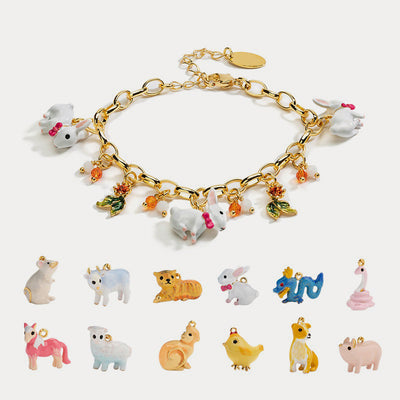
Explore WiAuGem designs inspired by the twelve Zodiac animals and traditional Chinese cultural symbols.
WiAuGem 12 Chinese Zodiac Rhinestone Pendant Necklace — Gold or Silver
https://www.wiaugem.com/products/wiaugen-12-chinese-zodiac-necklace
Choose the Zodiac animal associated with your birth year and select a gold-tone or silver-tone finish.
The detailed animal pendant and rhinestone accents turn a meaningful Zodiac symbol into an elegant everyday accessory.
WiAuGem 12 Chinese Zodiac Red Enamel String Bracelet
https://www.wiaugem.com/products/wiaugem-chinese-zodiac-necklace-12-zodiac-animal-jewelry
This design combines a Chinese Zodiac animal with a red string bracelet.
In Chinese culture, red is traditionally associated with happiness, vitality, celebration, and auspicious beginnings.
The bracelet brings together your personal Zodiac symbol and the traditional meaning of the color red.
WiAuGem 12 Chinese Zodiac Hetian Jade Peace Buckle Necklace
https://www.wiaugem.com/products/wiaugem-chinese-zodiac-peace-buckle-necklace
This necklace combines a Chinese Zodiac design with the traditional Chinese Peace Buckle, known as Ping An Kou.
The Peace Buckle is a classic circular jade design with an opening in the center. Its continuous shape traditionally symbolizes peace, wholeness, and continuity.
Hetian Jade has a long history in Chinese jade culture and is traditionally valued for its smooth texture and cultural symbolism.
11. Frequently Asked Questions About the Chinese Zodiac Rabbit
1. What number is the Rabbit in the Chinese Zodiac?
The Rabbit is the fourth animal in the Chinese Zodiac. It is traditionally associated with gentleness, intelligence, alertness, and good fortune.
2. What element is the Chinese Zodiac Rabbit?
The Rabbit's Earthly Branch is Mao, which is associated with Yin Wood. However, the Heavenly Stem element and Na Yin classification differ depending on the birth year.
3. What time is associated with the Rabbit?
The Rabbit corresponds to the Mao hour, traditionally from 5 AM to 7 AM.
4. Which Chinese Zodiac signs are most compatible with the Rabbit?
The Rabbit forms a Three Harmony group with the Goat and Pig. Its traditional Six Harmony partner is the Dog.
5. Which sign clashes with the Rabbit?
The Rooster is the Rabbit's traditional Six Clash partner. This symbolizes differences between the two signs; it does not mean that two people are destined to have relationship problems.
6. What type of Rabbit is someone born in 1987?
1987 is the Ding Mao year, traditionally known as the Fire Rabbit year. Its Na Yin classification is Fire in the Furnace.
7. What type of Rabbit is someone born in 1999?
1999 is the Ji Mao year, traditionally known as the Earth Rabbit year. Its Na Yin classification is Earth of the City Wall.
8. What type of Rabbit is someone born in 2011?
2011 is the Xin Mao year, traditionally known as the Metal Rabbit year. Its Na Yin classification is Pine and Cypress Wood.
9. What type of Rabbit is someone born in 2023?
2023 is the Gui Mao year, traditionally known as the Water Rabbit year. Its Na Yin classification is Gold Foil Metal.
10. What type of Rabbit will someone born in 2035 be?
2035 is the Yi Mao year, traditionally known as the Wood Rabbit year. Its Na Yin classification is Great Stream Water.
11. Can your Chinese Zodiac sign reveal your entire destiny?
No. Your Zodiac animal is only one part of traditional Chinese metaphysics. A complete Bazi analysis considers your birth year, month, day, and exact time.
Discover What Your Chinese Zodiac Says About You
The Chinese Zodiac is much more than twelve animal signs.
Each sign is connected to traditional timekeeping, the Five Elements, Yin and Yang, and relationships between the zodiac animals.
Your birth year offers one part of the picture. Your exact birth date and time can reveal more through the traditional Bazi system.
Want to explore what your Chinese Zodiac says about your personality, relationships, money, career, and potential opportunities?
Get your free Chinese Zodiac reading from WiAuGem and discover what your birth-year animal represents.
Get Your Free Chinese Zodiac Reading
References and Further Reading
The following sources support the cultural and calendar background discussed in this article. Personality, relationship, career, and wealth descriptions are presented as traditional symbolic interpretations, not scientific predictions.
1. Smithsonian Institution — Hirshhorn Museum: Ai Weiwei: Circle of Animals – Rabbit
Discusses the Rabbit's traditional association with the Moon, the Jade Rabbit legend, and the Rabbit's traditional time period of 5–7 AM.
https://hirshhorn.si.edu/explore/zodiac-heads-rabbit/
2. National Heritage Board, Asian Civilisations Museum — Rabbit
Provides cultural background on the Rabbit in Chinese art and folklore, including the Moon Rabbit and its association with longevity.
https://www.nhb.gov.sg/acm/-/media/acm/acm2017/documents/education-resources/resource---rabbit.pdf
3. Palace Museum — White Jade Rabbit of the Twelve Zodiac Animals
Explains the traditional connection between the Rabbit, the Mao time period, and the hours from 5 AM to 7 AM.
https://www.dpm.org.cn/collection/jade/233254.html
4. UAYA Foundation — Ganzhi: Heavenly Stems and Earthly Branches
Introduces the ten Heavenly Stems, twelve Earthly Branches, and the 60 Jiazi cycle.
https://uaya.org/reference/ganzhi/
5. Feng Shui School — Table of Heavenly Stems and Earthly Branches (60 Jiazi)
Provides a reference table for the traditional Stem-Branch year combinations.
https://www.fengshuischool.com/media/Jia_Zi.pdf
6. BaziTools — 60 Jiazi and Na Yin Reference
Provides a detailed 60 Jiazi table with corresponding Na Yin classifications, including the Rabbit combinations.
Disclaimer: This article introduces traditional Chinese Zodiac culture and metaphysical symbolism for cultural interest and personal reflection. These interpretations are not scientifically established predictions and should not replace professional financial or personal advice.